

The legal industry has always relied on trust, responsiveness, and strong client relationships. While legal expertise remains the foundation of every successful practice, client expectations have changed dramatically over the past few years. Today, potential clients expect immediate answers, fast communication, and a smooth intake process regardless of when they contact a law firm.
Whether someone has been injured in a car accident, arrested for DUI, involved in a family dispute, or needs urgent legal advice, they rarely want to wait until the next business day to speak with someone. Instead, they expect a professional response the moment they call.
For many firms, meeting these expectations has become increasingly difficult. Hiring multiple receptionists to cover evenings, weekends, and holidays is expensive. Traditional answering services often provide inconsistent client experiences. Voicemail frequently results in lost opportunities.
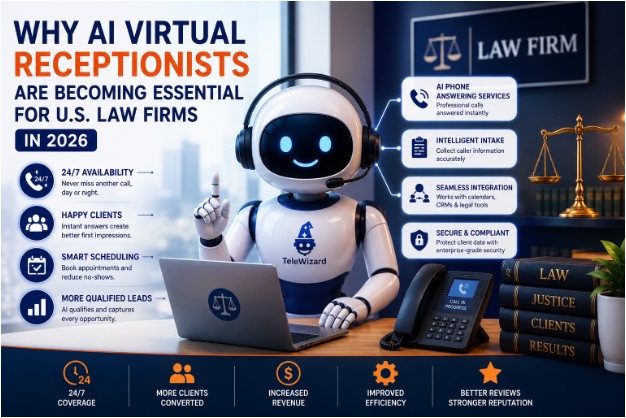
This changing landscape explains why more U.S. law firms are investing in AI Phone Answering Services and intelligent virtual receptionists. Rather than replacing legal professionals, artificial intelligence is helping firms improve client communication, increase efficiency, and capture more qualified leads around the clock.
Among the companies driving this transformation is Telewizard, a platform designed to help businesses deliver professional AI-powered client communication whenever prospective clients need assistance.
The Modern Legal Client Expects Immediate Communication
Legal emergencies don’t happen on a schedule.
Someone arrested late Friday night can’t wait until Monday morning.
An injured driver involved in a highway accident wants immediate legal guidance.
Parents involved in emergency custody matters often seek help outside normal office hours.
Because of smartphones and instant digital services, consumers have grown accustomed to receiving assistance immediately.
This expectation now extends to legal services.
If one law firm doesn’t answer, another one usually will.
The competition for new clients begins with the very first phone call.
The Traditional Reception Model Is Becoming Difficult to Maintain
Many firms still rely entirely on in-house receptionists.
While experienced receptionists remain incredibly valuable, several challenges have become increasingly common:
- Rising staffing costs
- Employee turnover
- Limited office hours
- Vacation coverage
- Lunch breaks
- High call volumes
- Weekend availability
- Holiday scheduling
Even the best receptionist cannot answer multiple calls simultaneously.
As firms continue growing, these operational limitations become more noticeable.
Every Missed Call Represents Lost Revenue
Every unanswered phone call has financial consequences.
Potential clients usually contact several attorneys before making a decision.
The first firm providing a helpful conversation often secures the consultation.
Missing one qualified personal injury case, criminal defense client, or estate planning engagement may represent thousands of dollars in future revenue.
When this happens repeatedly throughout the year, the financial impact becomes substantial.
What Is an AI Virtual Receptionist?
An AI virtual receptionist is an intelligent communication system capable of handling phone conversations naturally and professionally.
Unlike traditional automated phone menus, modern AI systems understand natural language.
They can:
- Answer questions
- Gather client information
- Schedule consultations
- Route urgent calls
- Qualify leads
- Provide business information
- Confirm appointments
- Support multiple languages
The conversation feels much closer to speaking with a knowledgeable receptionist than interacting with a traditional phone tree.
Why AI Phone Answering Services Continue Growing
Artificial intelligence has improved significantly over the last few years.
Speech recognition has become remarkably accurate.
Natural language processing allows AI to understand conversational speech.
Voice synthesis now sounds more natural than ever.
These improvements have made AI Phone Answering Services practical for professional industries like law.
Rather than frustrating callers, modern AI creates smooth, efficient interactions that improve client satisfaction.
Consistent Client Experiences
Consistency matters.
Different receptionists naturally communicate differently.
Some gather detailed information.
Others may overlook important questions.
Busy days often reduce call quality.
Artificial intelligence removes much of this inconsistency.
Every caller receives:
- Professional greetings
- Accurate information
- Structured intake
- Consistent tone
- Reliable scheduling
This consistency strengthens the firm’s overall client experience.
Supporting Receptionists Instead of Replacing Them
One common misunderstanding is that AI eliminates receptionist jobs.
In reality, many successful firms use AI alongside their administrative staff.
Routine calls are handled automatically.
Frequently asked questions receive immediate answers.
Appointment scheduling becomes faster.
Receptionists spend more time helping existing clients and handling complex situations.
This creates a better working environment for employees while improving client service.
Better Availability
One of AI’s greatest advantages is availability.
Unlike human staff, AI never becomes tired.
It doesn’t take vacations.
It doesn’t require lunch breaks.
It remains available:
- 24 hours a day
- Seven days a week
- Holidays
- Weekends
- Even during high call volume
This constant availability helps firms capture opportunities that would otherwise be lost.
Faster Client Intake
The intake process directly affects conversion rates.
When prospective clients spend less time waiting, they become more likely to schedule consultations.
AI can immediately collect essential information including:
- Name
- Contact information
- Practice area
- Incident details
- Preferred appointment time
- Urgency level
Attorneys receive organized information before consultations begin.
Better Lead Qualification
Not every caller requires immediate attorney involvement.
AI can identify:
- High-priority cases
- Emergency situations
- Existing clients
- New consultations
- Administrative questions
Calls can then be directed appropriately, allowing attorneys to focus on legal work instead of administrative screening.
Improving Staff Productivity
Administrative teams often spend significant time answering repetitive questions.
Office hours.
Directions.
Consultation availability.
Appointment confirmations.
Payment questions.
These routine conversations consume valuable staff time.
AI handles many of these inquiries instantly, allowing employees to focus on more meaningful responsibilities.
Calendar Integration
Modern virtual receptionists integrate with scheduling platforms.
Appointments can be booked automatically.
Confirmation messages are sent instantly.
Rescheduling becomes easier.
This reduces scheduling conflicts while creating a smoother experience for prospective clients.
Supporting Multilingual Clients
Many law firms serve diverse communities.
Language barriers often create unnecessary communication challenges.
AI systems capable of supporting multiple languages allow firms to provide better service to clients who feel more comfortable communicating in their native language.
This expands accessibility while improving client satisfaction.
Data Collection and Analytics
Modern communication platforms generate valuable operational insights.
Law firms can monitor:
- Call volume
- Peak hours
- Missed opportunities
- Conversion trends
- Appointment rates
- Frequently asked questions
These analytics support better business decisions.
Security and Professionalism
Legal professionals require confidentiality.
Reputable AI communication platforms prioritize secure handling of client information while maintaining professional interactions throughout every conversation.
This helps firms improve efficiency without compromising client trust.
Why More Firms Are Choosing Telewizard
As AI adoption continues increasing, specialized platforms have become increasingly attractive to law firms.
Telewizard combines conversational AI with intelligent business communication designed specifically to improve client interactions.
Instead of relying exclusively on voicemail or limited office hours, firms can maintain professional communication every hour of every day.
This allows attorneys and staff to remain focused on delivering legal services while ensuring prospective clients receive prompt, helpful responses.
The Competitive Advantage
Law firms adopting AI today gain several competitive advantages:
- Better client responsiveness
- Higher lead conversion
- Improved operational efficiency
- Lower administrative workload
- Greater scheduling flexibility
- Stronger first impressions
- Increased client satisfaction
As more firms embrace technology, responsiveness itself becomes a competitive differentiator.
Preparing for the Future of Legal Intake
Artificial intelligence is rapidly becoming part of everyday legal operations.
From document automation to client communication, AI helps firms deliver faster and more consistent service.
Virtual receptionists represent one of the most practical applications because they directly affect every prospective client’s first interaction.
The firms investing in better communication today will likely build stronger reputations, improve client experiences, and capture more opportunities in the years ahead.
Conclusion
The legal industry continues evolving alongside client expectations.
Modern consumers expect immediate communication, professional service, and convenient access whenever legal questions arise.
Traditional reception models remain valuable but often struggle to provide around-the-clock availability without significant staffing costs.
That’s why AI Phone Answering Services have become an increasingly important solution for forward-thinking law firms.
Rather than replacing human employees, AI strengthens legal operations by improving responsiveness, streamlining intake, and ensuring every caller receives professional attention.
Platforms like Telewizard demonstrate how intelligent communication technology can help law firms deliver better client experiences while capturing more opportunities in an increasingly competitive legal marketplace.
For firms looking to improve client intake, reduce missed calls, and modernize communication, AI-powered virtual receptionists are quickly becoming not just an advantage—but an essential part of legal practice in 2026.

